
Data Security and Privacy: How They Differ and Connect



Your team passes a security audit with clean results, then a regulator asks why the customer database still holds records from accounts closed three years ago. Both findings can exist at once. Data security protects data from unauthorized access, alteration, and loss, while data privacy decides whether personal data should be collected and used at all, and under what rules. In the IBM 2025 Cost of a Data Breach study, the average breach cost was USD 4.44 million, and organizations took an average of 241 days to identify and contain a breach.
Those figures describe one kind of failure: someone got in. Privacy fails differently, often with no attacker involved, when a company gathers more than it needs or uses data for purposes nobody agreed to. You might be reviewing a vendor's security questionnaire, updating an app's privacy settings, or deciding whether customer information can go into an AI tool. Each of those calls needs data security and privacy sharing controls, evidence, and ownership, because the two disciplines answer different questions.
Table of Contents
- Security and Privacy Compared at a Glance
- Why Security Protects Data and Privacy Governs It
- Design for less linkable data
Security and Privacy Compared at a Glance
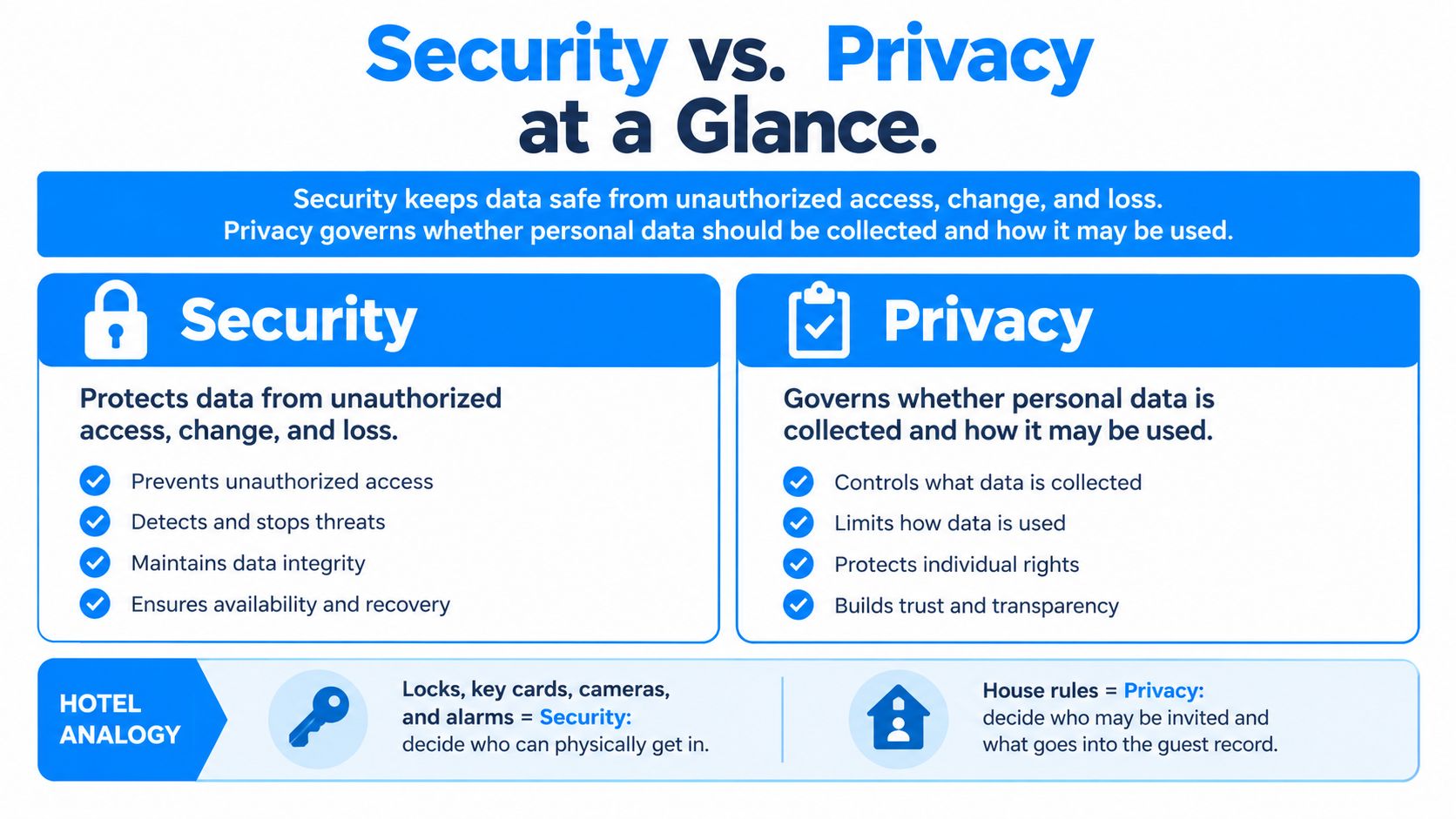
Security asks whether unauthorized people can access, change, or destroy data. Privacy asks whether personal data should be collected and used at all, for what purpose, and for how long.
| Criterion | Data security | Data privacy |
|---|---|---|
| Core question | Can unauthorized people access, change, or destroy the data? | Should this personal data be collected and used at all, and for what purpose? |
| Protects against | Attackers, malicious insiders, ransomware, and outages | Misuse, over-collection, unexpected secondary use, and unlawful sharing by the organization itself |
| Typical owner | CISO and security operations | Privacy officer or DPO, working with legal and product teams |
| Main controls | Encryption, MFA, access control, monitoring, and backups | Purpose limitation, data minimization, notice and consent, retention schedules, and individual rights |
| Success measure | Incidents prevented, and time to detect and contain them | Processing is justified, rights requests are answered on time, and data is deleted on schedule |
| How failure looks | A breach through stolen credentials | Lawfully secured data kept for years beyond its need |
| Can it work alone? | Yes, but a secure system can still hold data it should never have collected | Only on paper if controls don't enforce the promises |
The difference becomes clear in two ordinary scenarios. A ransomware attack encrypts patient records, blocking authorized staff from accessing them. That's a security failure: the organization didn't preserve access to information when people needed it. A retailer, by contrast, might protect purchase histories with strong encryption and restricted access but keep them for ten years for a purpose it never explained. The data may be secure, but holding and using it that way raises a privacy problem.
Security teams often lead on the first scenario. A CISO and security operations team manage safeguards such as access controls, monitoring, and backups. A privacy officer or data protection officer (DPO) typically works with legal and product teams to decide what information the organization needs, how it can be used, and when it should be deleted. Their responsibilities differ, but they need to coordinate on the same systems and records.
A useful test for any dataset is simple: Who should be able to see this, and should we hold it at all?
Why Security Protects Data and Privacy Governs It
Think of a hotel. Its door locks, key cards, cameras, and alarms are security controls: they help determine who can physically get into a room or staff area. Its house rules are about privacy: who may be invited, what details go into the guest register, how long that register is kept, and whether the hotel shares it with partners.
Personal data is information that identifies someone or can be linked to them. Names and email addresses are obvious examples. Device IDs and location trails can also identify or help track a person, even when a name isn't attached.
Now consider two hotels. The first has excellent locks and carefully limits staff access to its guest register. But it keeps detailed histories forever and sells them to marketing partners without a clear reason. Its security may be strong, but its handling of guest information isn't private. The second hotel promises discretion but leaves a back door open. Its privacy promise doesn't protect anyone if a stranger can walk in and take the register.
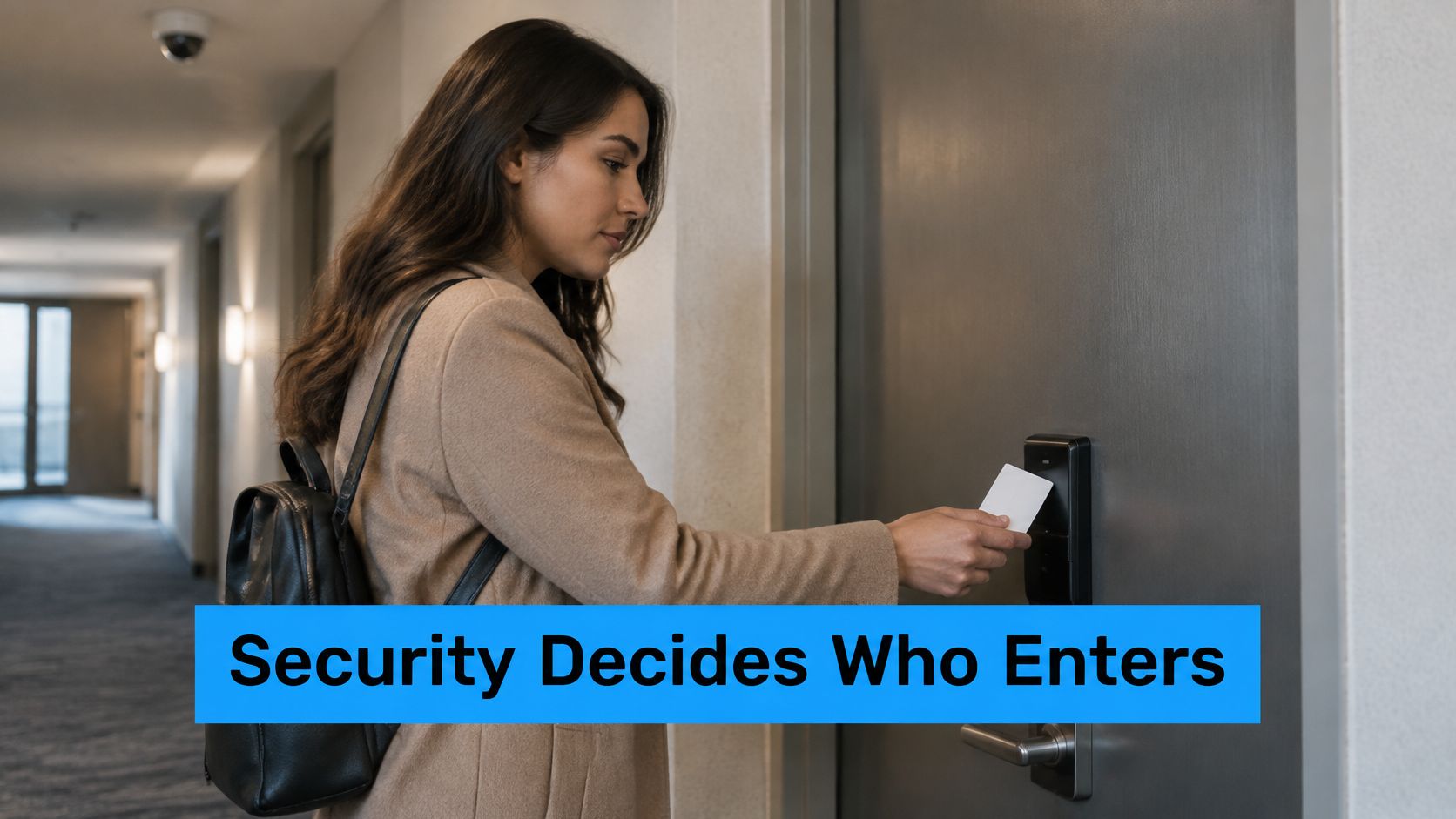
Security decides who can get in, and privacy decides what should be in the room at all.
For an organization, the guest register is the dataset, the guest is the individual, and the front desk represents the teams that handle the information. Those teams need rules for access as well as collection and use. Strong information governance practices help connect those decisions, so a promise made in a policy has an owner and is reflected in day-to-day operations.
Controls That Serve Both Goals
A single control can satisfy an auditor and still leave people overexposed. The same lock has to answer two questions: who can open the cabinet, and whether the cabinet should hold those files at all. Encryption can make a stolen copy harder to read, while also limiting exposure of the personal fields in that copy. Access restrictions can block an intruder and keep employees from seeing personal data they do not need for their work.
| Control | Security purpose | Privacy purpose |
|---|---|---|
| Encryption at rest and in transit | Blocks reading data if copies are stolen | Limits exposure of personal fields if copies circulate |
| Role-based access control | Stops unauthorized staff and attackers | Ensures only people with a purpose see personal data |
| Audit logging | Detects intrusions and supports incident tracing | Logs can hold personal data, so minimize recorded fields |
| Tokenization | Reduces the value of stolen records | Replaces direct identifiers before analytics |
| De-identification | Limits downstream harm from a leak | Reduces linkability to individuals, but requires re-identification testing |
| Retention and deletion | Shrinks what an attacker can steal | Meets storage limitation obligations |
| Backup and recovery | Restores service after ransomware | Must also account for deletion requests in backup copies |
The logging row shows why shared controls need careful design. Security staff need records of important events, such as who accessed a system or changed a permission. Logs can also capture names, identifiers, or other personal information, creating a second dataset with its own access and retention risks. Treat logging as its own data store: decide which events need to be recorded, restrict unnecessary personal fields, document retention requirements, and review whether logs still serve a security purpose.
Design for less linkable data
Privacy engineering guidance, including NIST's work on disassociability, encourages organizations to reduce how easily data can be observed, linked, or identified. Local processing, privacy-preserving cryptography, tokenization, and de-identification all push in that direction. Keeping computation on a device, for example, can reduce unnecessary transmission to a central system. Tokenization substitutes surrogate values for direct identifiers, so analytics can use records without routinely exposing names or account numbers.
De-identification is not a guarantee that information can never identify someone. Masking, differential privacy, and synthetic data each have different uses and limits. Test whether records could be linked back to people through timestamps, quasi-identifiers, or external datasets, and choose a method that fits both the analytical task and the remaining privacy risk. Separating identity records from operational data and protecting re-identification keys with distinct access controls can reduce the chance that one dataset reveals everything.
Retention and backups also require coordination. Deleting a live record may honor a retention limit, but an organization should also know how that deletion request applies to its backup and recovery process. At that point, the two disciplines either share ownership or fail separately: security can prove the door stayed locked while privacy still cannot explain why so much personal data was inside the room. Connecting compliance controls to ongoing defense means documenting how the rule works in practice, assigning an owner, and keeping evidence that the control operated as intended.
How Laws Turn Both Goals Into Obligations
Cyber incidents cross borders, so privacy and security responsibilities can overlap. The European Union Agency for Cybersecurity recorded 11,079 publicly observed cybersecurity incidents in its 2024 threat assessment, including 322 incidents targeting two or more EU Member States. The ENISA 2024 Threat Landscape illustrates why a single incident can involve multiple organizations, suppliers, and jurisdictions, each with its own response and reporting duties.
The EU General Data Protection Regulation (GDPR) became applicable on 25 May 2018. Its principles include purpose limitation, data minimization, security, accountability, and individual rights. Security is therefore part of a privacy framework, not a substitute for one. Organizations need to show that their safeguards are actually implemented and supported by evidence, not merely described in a policy.
| Regime | Scope | Privacy focus | Security focus |
|---|---|---|---|
| GDPR (EU) | Personal data of people in the EU | Purpose limitation, data minimization, and individual rights | Integrity and confidentiality principle, plus accountability |
| HIPAA (US health data) | Protected health information held by covered entities and business associates | Privacy Rule on uses and disclosures | Security Rule safeguards and Breach Notification Rule |
| PCI DSS | Payment card data | Limited direct privacy focus | Security requirements for storing, processing, and transmitting card data |
| NIST 800-171 and CMMC (US defense) | Controlled unclassified information in contractor systems | Limited direct privacy focus | Security requirements with assessment levels |
| NIST Privacy Framework | Any organization, voluntary | Risk-based privacy outcomes | Relies on security controls to deliver those outcomes |
A U.S. clinic that treats people from the EU may need to consider more than one regime. A retailer serving customers across borders may likewise need to account for different rules governing personal information and payment data. The answer depends on the data, the organization, and the activities involved, so teams should map those facts before deciding which obligations apply.
A privacy policy without evidence of operating safeguards isn't enough. Keep records of risk assessments, control checks, remediation, access reviews, and incident response so the organization can demonstrate what it did and when. Understanding HIPAA security requirements also means linking the written rule to the controls and records that support it.
What Breach Costs Reveal About Both Risks
IBM's 2025 Cost of a Data Breach study analyzed breaches experienced by 600 organizations across 17 industries worldwide between March 2024 and February 2025. The IBM 2025 study found that the global average breach cost was USD 4.44 million, down from USD 4.88 million in 2024.
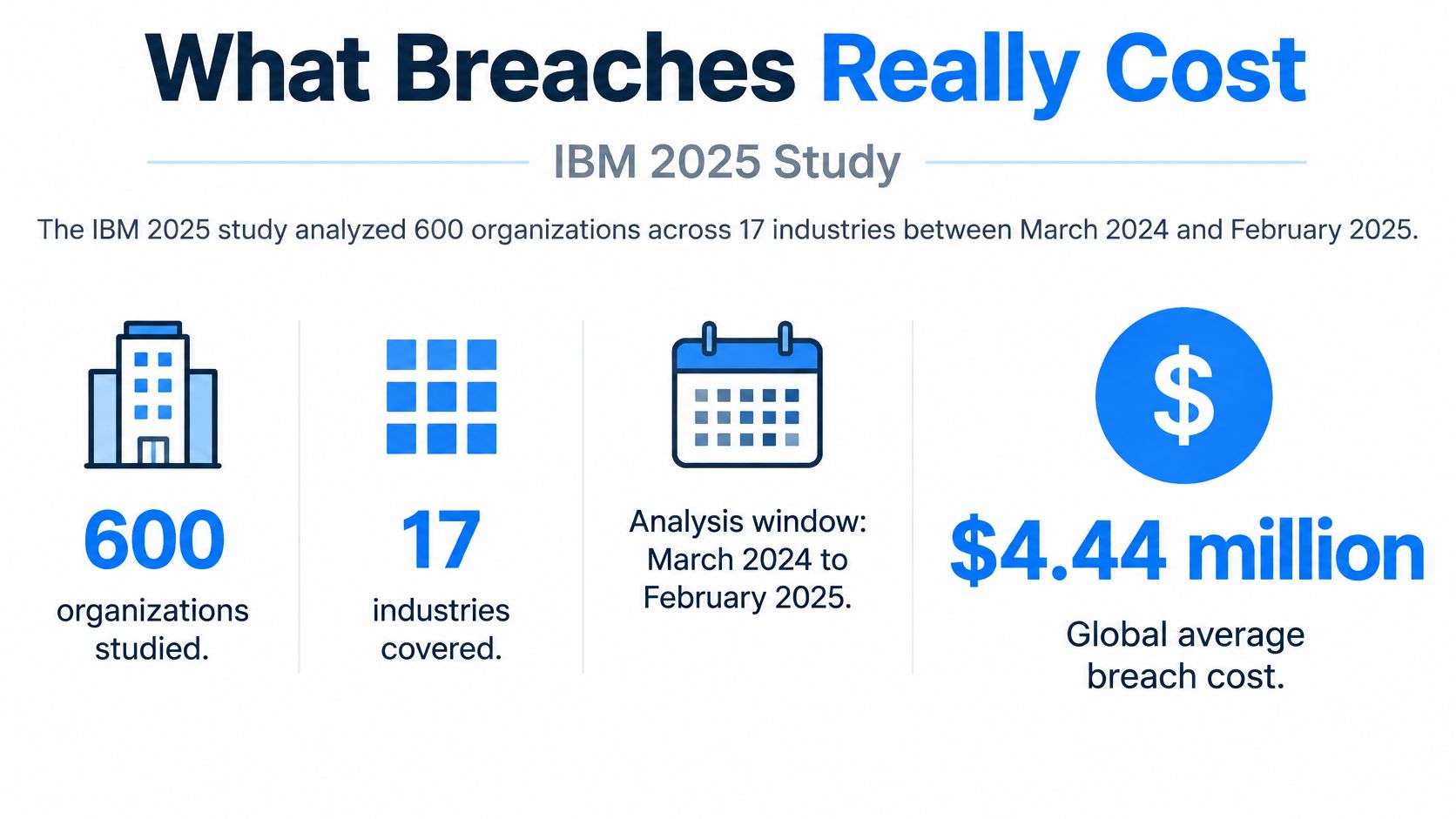
The study's figures show both the improvement in containment and the places where exposure remains costly:
| Measure | Value | Context |
|---|---|---|
| Global average breach cost | USD 4.44 million | Down 9% from USD 4.88 million in 2024 |
| Time to identify and contain | 241 days | Lowest in nine years, 17 days shorter than the prior year |
| Phishing, most common initial vector | 16% of breaches | USD 4.8 million average cost |
| Supply-chain compromise, second vector | 15% of breaches | USD 4.91 million average cost |
| Healthcare sector average | USD 7.42 million | Highest sector average |
| United States average | USD 10.22 million | Record, and 9% higher than the prior year |
Faster identification and containment is a security gain: teams can find an intrusion and limit what it disrupts sooner. It matters for privacy, too. While an attacker has access, more records and more people may be exposed, and the organization may need to assess notification duties. The 241-day average makes the point that containment isn't just a technical milestone. It can influence the scale of harm to individuals.
The falling global average doesn't mean every organization is safer or that every incident is less serious. Healthcare still had the highest sector-specific average cost, reflecting the financial exposure associated with sensitive information, reliance on digital systems, and regulatory obligations. The U.S. average also moved in the opposite direction, reaching a record despite the decline in the global figure.
The figures are a reason to keep governance, access controls, monitoring, incident response, and evidence running continuously. An organization that checks controls only before an audit may miss a new supplier risk, an access change, or an incident that needs a faster response.
AI Data Flows and Life After a Breach
AI governance often gets treated as a policy-writing task. The more practical question is who and what can access sensitive information as it moves through prompts, retrieved documents, outputs, and logs. In IBM's 2025 breach research, 97% of AI-related breaches involved AI systems without proper access controls. The report also found that 63% of breached organizations lacked an AI-governance policy or were still developing one, and 61% lacked AI-governance technologies.
For every AI tool, answer four operational questions:
- Access: Which employees, vendors, and AI agents can reach sensitive data?
- Classification: How are prompts, retrieved documents, model outputs, and logs classified?
- Retention: How long does the tool or its provider retain each type of information?
- Deletion: Who can remove the information, and how can the organization confirm it happened?
These answers matter whether staff are using an approved enterprise tool or a public generative-AI service. A blanket ban may not reveal shadow use, while a high-level acceptable-use policy may not explain what a provider retains or how employees should handle sensitive prompts. A workable AI governance approach connects access, data minimization, vendor terms, monitoring, incident response, and evidence.
Privacy work also continues after information leaves the organization. In a 2025 survey of more than 14,000 consumers across 14 countries, 63% said too much responsibility for data protection falls on consumers, while 86% expected some form of data-privacy rights, according to the Thales 2025 Digital Trust Index. For organizations, that means limiting what they share with processors, requiring deletion by contract where appropriate, reviewing onward transfers, and explaining what an access, correction, or deletion request can realistically achieve. Tokenization and access controls should apply to AI prompts and logs as well as to other sensitive datasets.
How to Build a Joint Security and Privacy Program
Start by prioritizing identity, vulnerabilities, and suppliers. In the 2025 Verizon Data Breach Investigations Report, compromised credentials were an initial-access vector in 22% of reviewed breaches, and vulnerability exploitation reached 20%. The human element appeared in roughly 60%, while third-party involvement doubled from 15% to 30%. In the median case, only 49% of a user's passwords across services were distinct, and credential stuffing reached 25% of authentication attempts in enterprise environments.
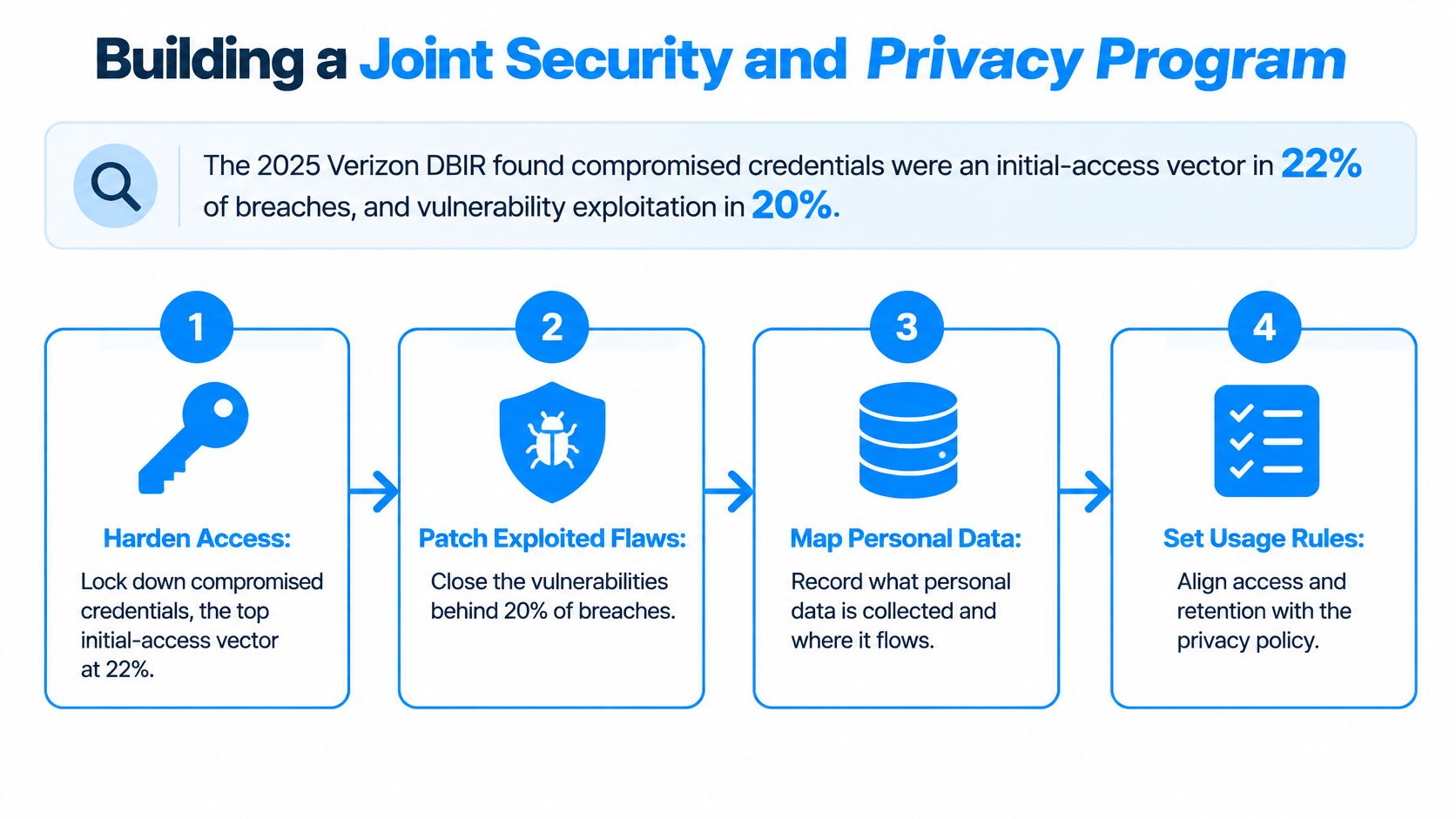
Inventory systems and datasets. Record what holds personal data, where it lives, and who owns it. You can't protect a dataset you haven't found. A common miss is listing the core database but overlooking exports, shared drives, and SaaS copies.
Classify the data. Mark each dataset by sensitivity and relevant regime, such as GDPR, HIPAA, PCI DSS, or CMMC. Controls should follow the information and its obligations, not just the system it happens to sit in.
Map data flows. Include vendors and cloud services, not only internal transfers. Every transfer can introduce a new access path, copy, or retention practice.
Set purpose and retention rules. Decide why each field is needed and when it should be deleted. Keeping information indefinitely by default turns unnecessary data into avoidable risk.
Apply shared controls. Use phishing-resistant multifactor authentication, least-privilege access, encryption, and tokenization for analytics. A common mistake is relying on an MFA setup with an SMS fallback that an attacker may be able to exploit.
Monitor identities and suppliers. Review third-party access continuously, monitor single sign-on activity, screen for breached passwords, and rotate exposed secrets quickly. Waiting until a contract renewal to review vendor access leaves long gaps.
Fix exploitable weaknesses first. Prioritize internet-facing assets and known exploited flaws. Measure remediation time and validate fixes with authenticated rescanning or penetration testing instead of treating a falling finding count as proof that the work is done.
Write response and rights-request playbooks. Assign owners for incident response and privacy requests, including who assesses notification duties. Name a responsible person, not just a team.
Keep evidence as controls operate. Record reviews, tests, approvals, and remediation on an ongoing schedule. Gathering evidence only before an audit can leave the organization unable to show what happened in the meantime.
Practical rule: Measure whether a control works in practice, not whether someone switched it on.
Phishing-resistant MFA, breached-password screening, password managers, SSO monitoring, risk-based authentication, and fast secret rotation address identity risks. For vulnerabilities, prioritize known exploited issues on internet-facing systems and test the fix. A control framework that reduces repeated compliance work can help teams use shared safeguards and evidence across overlapping requirements. Privaxi drafts and helps implement HIPAA policies adapted to each customer's real-world practices.
Start With a Data Inventory This Week
List the ten to twenty systems that hold the most personal data. For each one, record the data types, purpose, retention period, people or roles with access, and applicable regime. That single list helps answer both questions: what could an attacker reach, and what should the organization stop holding?
Take four items into any provider discussion: your system list, the regimes in scope, recent audit findings, and incidents from the past year. Those details help turn a broad concern into a focused assessment of the systems and controls that matter most.
Privaxi helps financial and healthcare organizations strengthen data security with NIST 800-53 compliance. Its security plans are designed around each business's specific needs, and its HIPAA compliance services address the Privacy Rule, Security Rule, and Breach Notification Rule. The inventory gives that work a practical starting point, but outcomes depend on the organization's environment.
Make the inventory the first measurable result you share with leadership: a record of where personal data lives, why it is held, and who is accountable for it.
Privaxi helps organizations assess security and compliance programs, implement controls, and maintain evidence for ongoing oversight. If you're ready to connect data protection rules with controls that work in practice, visit Privaxi to discuss an approach suited to your organization.
Related Articles


Secure Your Business's Future
Contact us today for a personalized consultation and see how we can tailor a security solution that fits your business needs perfectly.
