

Red Team vs Penetration Testing: Key Differences Explained



A penetration test asks which weaknesses can be exploited within a defined scope, while a red team asks whether an adversary can reach a business objective before defenders stop it. That's why the popular advice to buy a red team because it's a more advanced penetration test is wrong. Choose the engagement by the decision you need to make, not by which label sounds more impressive.
Table of Contents
Red Team vs Penetration Testing at a Glance
Both engagements involve authorized hacking. They differ in what the buyer can reasonably conclude from the results: whether specified assets have exploitable weaknesses, or whether the organization can interrupt a realistic attack.
Penetration test and red team exercise compared at a glance
| Dimension | Penetration Test | Red Team Exercise |
|---|---|---|
| Primary question | Which weaknesses can be exploited within scope? | Can an adversary reach a business objective without being stopped? |
| Typical objective | Validate and document exploitable vulnerabilities | Test detection, response and containment |
| Example | Test of a customer portal | Reach card data by any authorized route |
| Scope | Defined systems, applications, networks or cloud workloads | A mission or business goal across technology, people and processes |
| Defender awareness | Usually known to the security team | Usually unknown to the defenders |
| Rules | Documented rules of engagement and permitted techniques | Rules of engagement plus stealth limits, stop conditions and safety controls |
| Main output | Prioritized vulnerability list with proof of exploitation and fixes | Attack narrative, timeline, detection gaps and response findings |
| Typical duration | Fixed testing window based on assets, access levels and validation effort | Scenario-based window allowing reconnaissance, execution and defender response |
The duration row is a purchasing rule, not a calendar promise. A complex application with multiple user roles may demand more effort than a tightly focused adversary simulation. Get the testing effort and completion conditions in writing rather than assuming the engagement name determines its length.
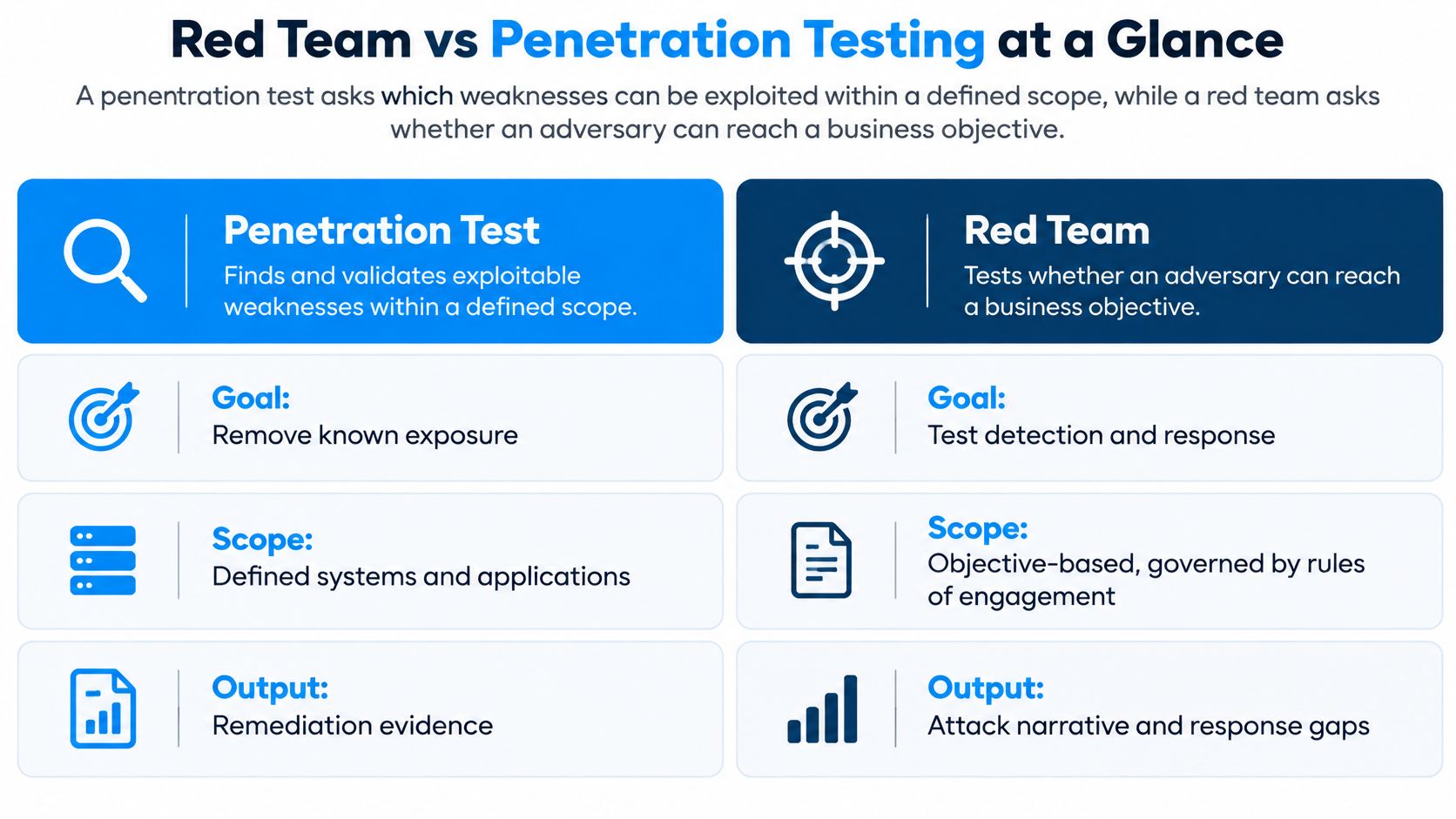
This visual summarizes the distinction.
Start with the decision
If you're approving a customer portal launch, you need evidence about authentication, authorization, exposed functions and sensitive-data handling. If leadership wants to know whether compromised employee credentials could expose payment data, a portal-only assessment won't answer that question.
Also distinguish either engagement from automated scanning. Our explanation of what penetration testing is and why a scan isn't enough addresses that purchasing mistake.
The first red team vs penetration testing decision is the question you need answered. The label comes afterward.
Objectives and Rules of Engagement Compared
NIST Special Publication 800-115 frames penetration testing as a controlled technical assessment in which testers target specified systems or components, work under predefined rules and verify whether vulnerabilities can be exploited. That framing matters because authorization and boundaries determine what the findings actually prove.
A tester who confirms an authorization flaw in a customer portal has demonstrated exposure in that portal. They haven't automatically established whether an attacker could compromise the payment processor, bypass the fraud team or export the customer database.
Establish authorization before execution
The rules of engagement should resolve operational questions before anyone sends test traffic:
- Authorization and scope: Identify the approving authority, asset owners, included environments and explicit exclusions.
- Permitted techniques: Define whether exploitation, password attacks, social engineering and persistence are allowed.
- Timing and communications: Set testing windows, notification arrangements and emergency contacts.
- Evidence handling: Specify collection limits, encryption, retention, access and deletion requirements.
A useful penetration testing scope names more than applications. It identifies user roles, APIs, integrations and administrative functions so the buyer knows which trust boundaries will be tested.
For example, permitting read-only database access doesn't authorize copying production patient records. Agree whether a harmless marker, limited metadata or an approved synthetic record will provide sufficient proof.
Give a red team controlled freedom
A red team pursues an operational outcome through the routes its authorization permits. Its operators may need application, identity, infrastructure and social-engineering skills because the viable path isn't necessarily confined to a single technical discipline.
That freedom needs additional governance. A small control cell, sometimes called a white cell, should know the exercise is happening, distinguish simulation activity from a genuine incident and have authority to halt operations.
Practical rule: Keep defenders unaware when realism requires it. Never leave the people responsible for safety unaware.
Document deconfliction contacts, prohibited targets and stop conditions, including service degradation or unexpected sensitive-data exposure. Confirm permission for third-party platforms and cloud-hosted systems; your ownership of an account doesn't grant unrestricted testing rights over the provider's infrastructure.
Write the objective as a single sentence before signing. An objective that only names a system and asks for weaknesses usually describes a penetration test. An objective that names a business outcome and the defensive response to evaluate points toward red teaming.
How Each Test Is Carried Out
Penetration testing follows a coverage plan. Red teaming follows an adversary scenario, adapting its route within the approved boundaries.
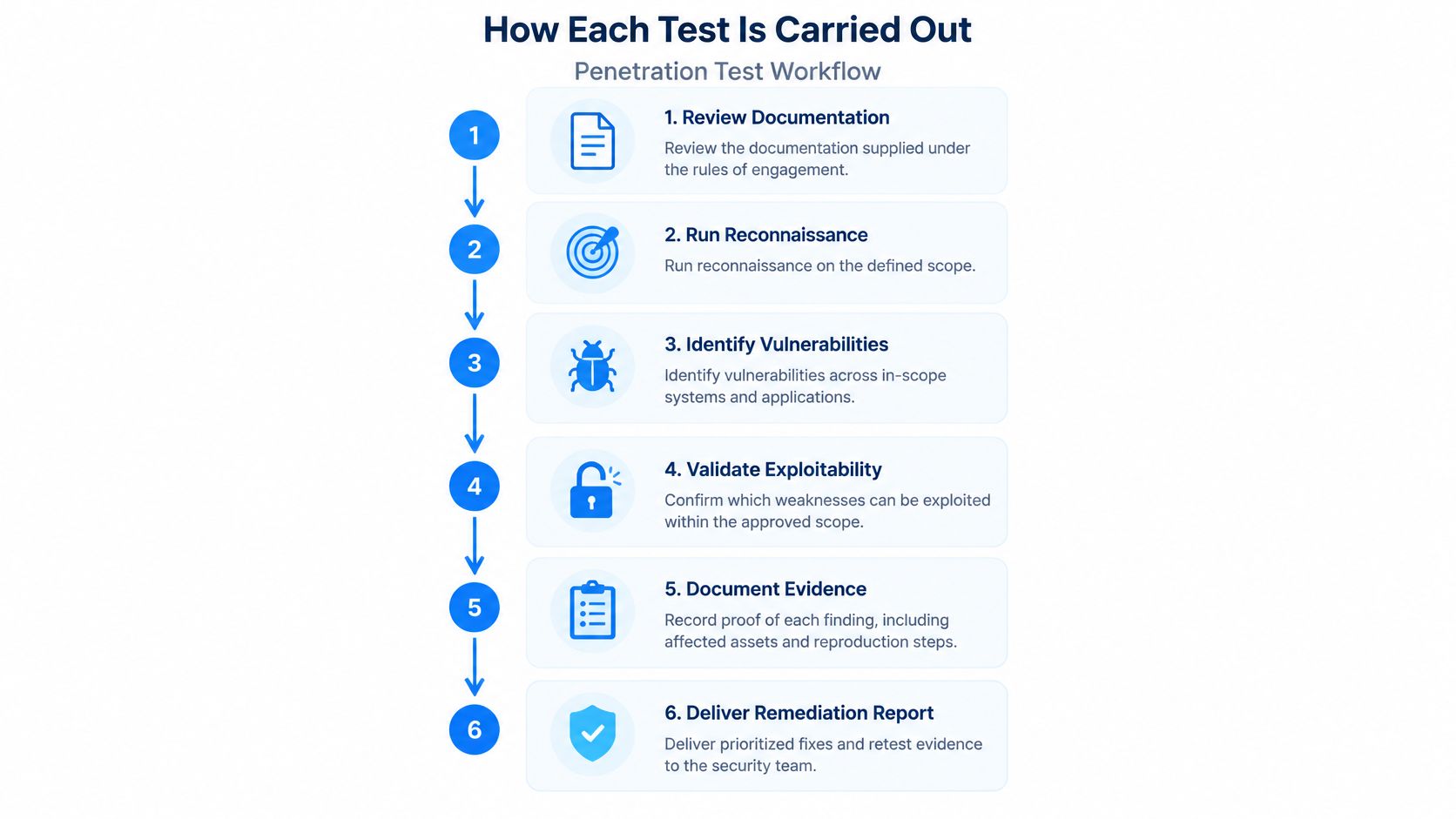
The penetration test workflow
- Review documentation. Establish architecture, user roles, dependencies and constraints from the material supplied under the rules of engagement.
- Run reconnaissance. Identify the reachable attack surface within the defined scope and reconcile it against the asset list.
- Identify vulnerabilities. Combine tooling with manual checks for access-control failures, business-logic weaknesses and configuration errors.
- Validate exploitation and capture proof. Confirm impact safely, recording affected assets and reproducible steps.
- Report and retest. Deliver prioritized fixes, then verify remediation against the original failure conditions.
The workflow separates finding a possible weakness from proving it.
White-box testing gives testers extensive documentation and access. Grey-box testing supplies partial knowledge or credentials; black-box testing supplies no prior technical knowledge beyond the authorized target. Less information shifts effort toward discovery, which can leave less time for deep validation under a fixed budget.
Black-box testing isn't automatically more rigorous. For an API with complex authorization rules, documented endpoints and representative accounts often produce better coverage. For an internet-facing perimeter, external penetration testing can examine what an unauthenticated outsider can discover and exploit.
Our Expert-Led Pen Testing uses human-led testing for applications, networks, cloud environments and complex attack paths.
The red team workflow
MITRE's threat-informed defense work provides a useful model for organizing exercises around adversary behaviors rather than a vulnerability checklist.
- Select an adversary profile using threat intelligence relevant to the organization.
- Build an executable scenario that connects behaviors into a plausible intrusion path.
- Rehearse with operators. Check tooling, safety controls and evidence capture.
- Execute against the objective, adapting within the rules as defenders react.
- Reconstruct the operation from operator records, telemetry and defensive actions.
An unannounced exercise can use a white cell while frontline defenders remain unaware. A purple exercise instead lets operators and defenders collaborate in real time, which is useful for improving detections but doesn't measure unaided response in the same way.
A penetration test generally stops a particular exploit at sufficient proof of impact. A red team continues along the authorized path until the objective, containment, a safety condition or the agreed endpoint determines the result.
Breadth Versus Depth
The important trade-off isn't shallow versus advanced. It's systematic technical coverage versus detailed evidence about an attack path and the defenses along it.
A penetration test can examine hosts, applications and APIs through authenticated and unauthenticated access. Testers can deliberately exercise separate roles and record weaknesses that have no relationship to one another. That breadth is useful when engineering teams need an actionable inventory.
A red team may ignore a low-impact flaw because exploiting it would create noise without advancing the objective. Buyers shouldn't interpret that choice as evidence that the flaw doesn't exist.
What a banking scenario reveals
Say a bank is preparing a new online banking application. A penetration test can examine account isolation, transaction authorization, session handling, API access and administrative privileges.
The resulting evidence tells application owners which controls failed and how to reproduce those failures. It doesn't establish whether the bank's security operations center, or SOC, would recognize an intrusion through an employee account.
Now give a red team an authorized objective: determine whether a phishing-driven compromise of a finance user can reach the core ledger before containment. Operators might investigate identity permissions, help desk recovery procedures, supplier access and escalation practices rather than attack the customer application at all.
The Bank for International Settlements' analysis of red-team testing frameworks describes this organizational-resilience focus, extending beyond isolated technical weaknesses to people and processes.
A longer vulnerability list doesn't prove that defenders performed worse. A shorter list doesn't prove that systems are safer.
Allocate effort deliberately
The bank needs different owners for the resulting work. Application engineers can fix authorization checks; identity administrators can reduce privilege paths; security operations leaders can repair investigation and escalation procedures.
Neither engagement guarantees exhaustive coverage. A penetration test still has time and access constraints, while a red team's chosen path may leave substantial parts of the environment untouched.
For buyers, the useful distinction is:
- Choose technical breadth when you need defined asset coverage, reproducible findings and engineering work packages.
- Choose defensive depth when you need to understand how identity, monitoring and operational decisions behave along a plausible intrusion.
- Preserve separate backlogs so fixing a software defect doesn't accidentally close an unresolved detection or process gap.
The penetration test usually produces the wider finding inventory. The red team produces more specific evidence about defensive performance on the path it exercised.
Metrics That Show Whether Each Test Worked
Don't merge penetration test and red team results into a single security score. Their coverage models and success criteria differ, so a combined score can hide exactly the weakness leadership needs to address.
MITRE's ATT&CK Evaluations methodology separates threat intelligence, red development, detection engineering and execution, documenting telemetry and defensive interactions. Buyers should make the same distinction between executing an attack behavior, observing it and responding effectively.
Metrics each test should report
| Metric Family | Penetration Test Measures | Red Team Measures |
|---|---|---|
| Coverage | Scoped asset coverage; authenticated versus unauthenticated testing | Percentage of planned techniques executed |
| Findings | Exploitable findings by severity; exploit reproducibility | Attack steps generating actionable alerts |
| Detection | Not the primary measure | Time to initial detection; analyst escalation accuracy |
| Response | Remediation aging; retest closure rate | Mean time to triage; mean time to contain |
| Outcome | Vulnerabilities closed and verified | Whether the defined objective was prevented |
Make the measurements interpretable
For penetration testing, asset coverage needs a denominator. A statement that testers assessed the application isn't enough if they couldn't access administrative functions or a critical API.
Separate authenticated from unauthenticated coverage, and record blocked testing. An unavailable account or unstable staging service is a coverage limitation, not a passed test.
Finding severity should reflect demonstrated impact and the affected business function. Exploit reproducibility gives engineers a reliable basis for repair; remediation aging shows unresolved exposure; retest closure confirms that the original exploit no longer works.
For red teams, execution coverage establishes what was actually tested. Unexecuted techniques belong in the limitations, not among controls assumed effective.
Detection measurements need agreed timestamps. Define whether initial detection means a raw alert, analyst recognition of malicious activity or declaration of an incident. Define triage and containment just as carefully, especially when calculating averages across different events.
Distinguish visibility from intervention
An alert isn't automatically actionable. Analysts need enough context to identify the affected account or asset, understand why the activity matters and choose a response.
Escalation accuracy should assess whether analysts involved the right people with the right urgency. Containment should mean a verified interruption of the attacker's access or progress, not merely opening a ticket.
Buyer's safeguard: Require timestamps and supporting evidence, not just a statement that the security tool detected the attack.
A red team that deliberately bypasses low-impact flaws can still deliver a strong assessment. A penetration test may reasonably emphasize discovery instead. Judge each against its commissioned purpose.
Require a reporting crosswalk that links each attack step to the control tested, telemetry generated, alert or investigation, response action and supporting audit evidence. Name an owner for every gap and distinguish missing controls from controls that existed but weren't operated effectively.
That gives leadership a defensible remediation plan rather than a score that obscures the underlying work.
When Each Test Fits and Where Each Falls Short
A red team detected and contained immediately may uncover fewer vulnerabilities than a penetration test while demonstrating stronger defensive maturity. An undetected engagement can reveal serious response failures without exploiting a severe software flaw, particularly when operators abuse legitimate access.
The stakes aren't limited to advanced evasion: Verizon's 2025 Data Breach Investigations Report analyzed more than 12,000 breaches and found that exploitation of vulnerabilities as an initial-access method increased by 34%, reaching 20% of breaches. Those findings support fixing exploitable exposure, but they don't establish that remediation alone will stop an attacker after entry.
Which test fits which situation
| Situation | Better Fit | Why |
|---|---|---|
| New application before launch | Penetration test | Confirms exploitable flaws in a defined scope before users arrive |
| Verifying remediation of known findings | Penetration test | Retest closure and proof of fix are the evidence needed |
| Compliance evidence for PCI DSS or HIPAA | Penetration test | Scoped, repeatable testing supports documented control validation; confirm the applicable assessment requirements |
| Tuning SOC detection and escalation | Red team | Shows which attack steps alerted, how quickly and where escalation failed |
| Board asks whether attackers can reach customer data | Red team | Tests the path to a named objective rather than isolated flaws |
| Third-party access or identity exposure concerns | Red team | Can include authorized help desk, identity and supplier paths beyond a conventional technical scope |
| Mature program wanting both | Penetration test, then red team | Clears known weaknesses first so the red team can focus on defensive performance |
Recognize the limits before buying
A narrowly scoped penetration test can miss connections between systems. An identity weakness outside the approved asset list may turn a minor application finding into a meaningful attack path, but testers can't freely cross the boundary to investigate.
A red team has the opposite limitation: success along a selected path says little about untested vulnerabilities elsewhere. Failure to reach the objective also isn't proof of universal protection. Time limits, safety exclusions and the selected adversary profile constrain the conclusion.
Our guide to penetration testing services can help frame the technical assessment side. We also offer Red Team Exercises: adversarial simulations that test people, process and technology against real-world tactics.
For buyers needing recurring vulnerability work, our Penetration Testing as a Service uncovers, prioritizes and remediates vulnerabilities, with findings connected to CYRIK for tracking, remediation and compliance outcomes.
Use the metric families above to define acceptance, rather than purchasing an engagement on finding volume alone. Our penetration testing findings are prioritized, actionable and aligned to the controls auditors care about, but the buyer still needs to match the evidence to the business question and applicable assessment scope.
Choose the Right Test Before You Commission Work
For most organizations, start with a penetration test to reduce known exposure and produce remediation evidence, then commission a red team when detection and response are measurable. That sequence gives engineers clear repairs before you spend effort evaluating how defenders handle a realistic intrusion.
The buying decision should begin with evidence requirements, not a preferred test label.

There are exceptions. A regulated firm with a completed breach investigation may prioritize a red team against its highest-value path to validate that corrective controls interrupt the relevant behaviors. An active incident needs incident response, not an exercise that could confuse the investigation.
Confirm these items before signing
- Objective: Write the decision the engagement must support in a single sentence.
- Assets and owners: Identify targets, dependencies, exclusions and accountable business owners.
- Authorization: Cover the permitted activity on third-party platforms and cloud services.
- Safety: Establish stop conditions, a reachable escalation contact and authority to pause.
- Measurement: Agree on coverage, detection, response or remediation measures appropriate to the test.
- Deliverables: Require technical evidence, limitations, named remediation owners and a crosswalk to controls and audit evidence.
Compare proposals against those commitments. A low headline price can conceal limited role coverage, excluded integrations or no retesting. Use our penetration testing cost guide to structure the budget discussion around scope and effort.
Use the accompanying video alongside your written scope review, not as a substitute for agreed acceptance criteria.
You don't have to begin with a large engagement. We offer a free executive-level penetration testing report that provides a board-ready snapshot of your company's security posture. For a bounded starting point, our targeted pilot can cover Compliance as a Service onboarding, a penetration test or a readiness sprint to quantify impact quickly.
Privaxi offers expert-led penetration testing and Red Team Exercises to answer different security questions: what needs fixing, and whether defenders can stop an adversary pursuing a business objective. Visit Privaxi to discuss the objective, authorized scope and evidence your organization needs before commissioning work.
Related Articles



Secure Your Business's Future
Contact us today for a personalized consultation and see how we can tailor a security solution that fits your business needs perfectly.
