
SIEM Tool vs Managed SIEM vs SOCaaS: What Should You Buy?



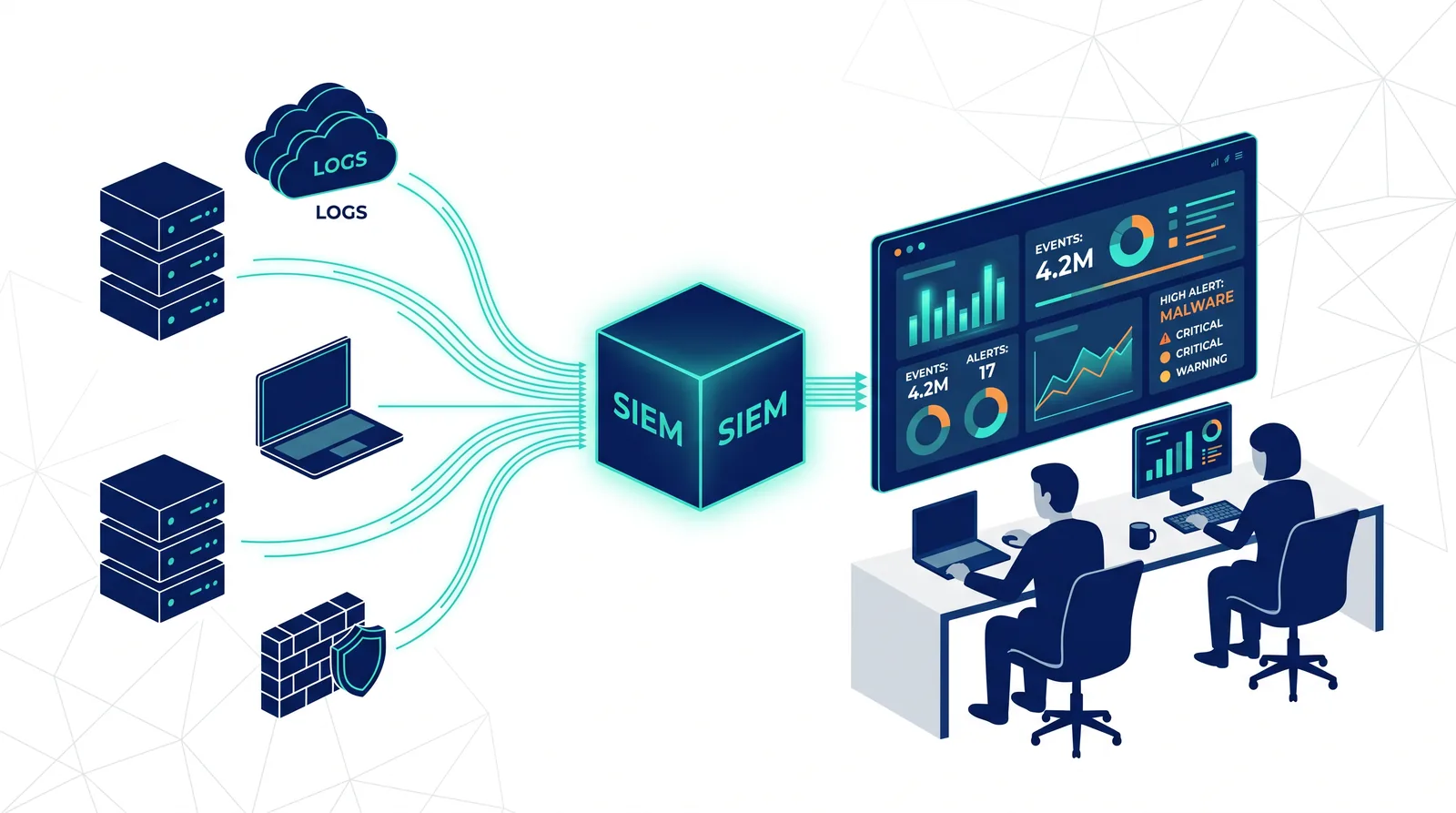
Quick answer: A SIEM tool is software that collects and correlates security logs and raises alerts. Managed SIEM means a provider runs that software for you. SOC as a service (SOCaaS) adds a team of analysts who monitor, investigate and respond around the clock. If you lack in-house security staff, a managed SIEM or SOCaaS usually delivers value faster than buying a SIEM tool on its own.
Logs are only useful if someone reads them. Every server, firewall, cloud account and application produces thousands of events a day, and hidden in them are the early signs of an attack. A SIEM exists to collect those events, connect the dots and raise an alert. The harder question is not what a SIEM does but who runs it, who watches it at 3 a.m. and what that costs.
This guide compares three ways to get that capability: buying a SIEM tool and running it yourself, using a managed SIEM, or outsourcing to a SOC as a service (SOCaaS). If you want to see how a managed option works, Privaxi's managed SIEM and SOC platform is one example.
What Is a SIEM Tool?
SIEM stands for security information and event management. A SIEM tool does four core jobs:
- Collects logs from servers, endpoints, network devices, cloud services and applications.
- Normalizes and stores the data so events from different systems can be compared.
- Correlates events using rules and analytics to find patterns that suggest an attack.
- Alerts and reports so analysts can investigate and auditors can see evidence.
The software alone does not provide security. It needs tuned detection rules, a steady stream of well-chosen log sources and people who can triage alerts. Without those, a SIEM tool becomes an expensive log archive that produces noise.
Option 1: Buy and Run a SIEM Tool Yourself
In this model you license or deploy a SIEM platform, connect your log sources and staff the monitoring yourself.
- Pros: maximum control, data stays with you and detections can be fully customized.
- Cons: you need skilled engineers to deploy, tune and maintain it, plus analysts to monitor it. Licensing often scales with data volume, which can make costs unpredictable.
- Best for: large organizations with a dedicated security team and mature processes.
Option 2: Managed SIEM
Managed SIEM means a provider deploys and operates the SIEM platform for you. They handle onboarding of log sources, maintenance, rule tuning and often first-line alert triage, while you keep visibility into the dashboards and reports.
- Pros: faster deployment, no need to hire platform engineers and more predictable pricing in many cases.
- Cons: you rely on the provider's expertise and processes, so the service level matters.
- Best for: mid-size organizations that want a SIEM for security and compliance but cannot staff it.
Option 3: SOC as a Service (SOCaaS)
SOCaaS goes beyond running the tool. A security operations center team monitors your environment around the clock, investigates alerts, escalates real incidents and helps you respond. The SIEM is the engine, but the people and process are the product.
- Pros: 24/7 coverage without building a team, access to experienced analysts and faster response.
- Cons: you need clear escalation paths and must trust the provider with sensitive data.
- Best for: organizations that need real monitoring and response but do not have the budget or headcount for an internal SOC.
Privaxi offers SOC as a Service as part of its managed security services, alongside vCISO support, with monitoring, incident response and compliance reporting.
SIEM Tool vs Managed SIEM vs SOCaaS: Comparison
SIEM for Compliance
Many organizations adopt a SIEM because a framework expects log management and monitoring. PCI DSS, HIPAA, HITRUST, ISO 27001, NIST 800-171 and CMMC all contain requirements for logging, monitoring and incident detection. A SIEM provides centralized logs and audit-ready records that make those controls easier to prove.
Privaxi describes its SIEM platform as built to support HIPAA, HITRUST, PCI DSS, CMMC, ISO 27001 and NIST frameworks. As with any tool, confirm with your assessor how the evidence maps to your specific controls. For a view of how monitoring fits into broader compliance, see why continuous compliance beats annual audits.
Key Features to Look for in a SIEM Tool
- Broad log source support for endpoints, network devices, cloud platforms and applications.
- Correlation and detection content that is maintained and tuned, not just a rule editor.
- Alert prioritization so analysts see the important events first.
- Automation or SOAR for common responses such as isolating a device or blocking an IP.
- Threat intelligence feeds to enrich alerts.
- Reporting aligned to your compliance frameworks.
- Flexible deployment across cloud, on-premises or hybrid environments.
- Transparent pricing without surprise ingestion fees.
How to Decide: Five Questions
- Do you have people to run it? If not, choose managed SIEM or SOCaaS.
- Do you need 24/7 coverage? Attacks do not keep office hours. If you cannot staff nights and weekends, you need a SOC.
- What are your compliance drivers? Frameworks that require log retention and monitoring favor a SIEM with built-in reporting.
- What is your log volume and growth? Data-volume pricing can escalate quickly.
- What is your response capability? Detection without response only tells you that you have been breached.
SIEM Alone Is Not Enough: Pair It With Testing
A SIEM detects attacks, but it cannot tell you where your weaknesses are. Penetration testing does that, and the two reinforce each other: tests show which attack paths your SIEM should detect, and SIEM alerts show whether those tests were noticed. Read our guide to penetration testing services and consider penetration testing as a service, which Privaxi's higher plans integrate with SIEM tooling.
Questions to Ask a Managed SIEM or SOCaaS Provider
- Is monitoring truly 24/7/365, and who are the analysts behind it?
- Which log sources are included, and how are new sources added?
- How are detection rules built and tuned for my environment?
- What is the response process, and which actions can the provider take automatically?
- What are the service levels for alert triage and escalation?
- How is pricing calculated, and are there ingestion or storage fees?
- Where is data stored, how long is it retained and who can access it?
- What compliance reporting is included, and can I see samples?
- Can I export my data and leave without losing history?
What Should Happen When a SIEM Alert Fires
- Detection. The SIEM correlates events and raises an alert with a severity.
- Triage. An analyst checks whether it is a real threat or a false positive.
- Investigation. The analyst collects context such as affected users, devices and related events.
- Containment. Actions such as isolating an endpoint or blocking an address stop the spread.
- Escalation. Serious incidents go to your named contacts with clear next steps.
- Recovery and lessons learned. Systems are restored, and detections are tuned to catch the pattern sooner.
The speed and clarity of this chain matter more than the number of dashboards. Ask any provider to walk through a recent, anonymized example.
Common Mistakes When Buying a SIEM Tool
- Buying the software before defining use cases. Start with the threats and compliance requirements you need to detect and prove.
- Ingesting everything. More data means more cost and more noise. Prioritize high-value sources.
- Ignoring tuning. Default rules generate false positives that analysts learn to ignore.
- No response plan. Alerts need owners and escalation paths. Our article on why reactive security fails explains the cost of waiting.
- Choosing on price alone. A cheap SIEM that nobody monitors is not security.
Frequently Asked Questions
What is a SIEM tool?
A SIEM tool collects and analyzes security logs from across your environment, correlates events to find suspicious activity and generates alerts and compliance reports.
What is the difference between a SIEM and a SOC?
A SIEM is software. A SOC, or security operations center, is the team and process that monitor alerts, investigate threats and respond. A SIEM is the main tool a SOC uses.
What is managed SIEM?
Managed SIEM is a service in which a provider deploys and operates the SIEM platform for you, including onboarding log sources and tuning detections, while you retain access to dashboards and reports.
What does SOCaaS include?
SOC as a service typically includes 24/7 monitoring, alert triage, investigation, incident escalation and reporting delivered by an external security operations team using a SIEM platform.
Do I need a SIEM for compliance?
Several frameworks, including PCI DSS, HIPAA, HITRUST, ISO 27001, NIST 800-171 and CMMC, require logging and monitoring controls. A SIEM is a common way to meet and evidence them, though it is not the only way. Confirm with your assessor.
Is SOCaaS better than buying a SIEM tool?
For organizations without a dedicated security team, usually yes, because it provides expertise and 24/7 coverage without hiring. Large organizations with mature teams may prefer to run their own.
Final Thoughts
The right SIEM tool decision is rarely about the software. It is about who will tune it, who will watch it and how fast someone can act. If you have a mature security team, running your own SIEM can make sense. If you do not, managed SIEM or SOC as a service gets you coverage and evidence sooner.
To see how a managed approach works in practice, explore Privaxi's managed SIEM and SOC platform or talk to us about SOC as a Service.
Related Articles


Secure Your Business's Future
Contact us today for a personalized consultation and see how we can tailor a security solution that fits your business needs perfectly.
