

PTaaS vs Traditional Penetration Testing: Which Model Fits You?



Quick answer: Penetration testing as a service (PTaaS) delivers penetration testing on a subscription, with continuous or recurring testing, a findings portal and built-in retesting. Traditional penetration testing is a one-off, scoped engagement that ends in a point-in-time report. PTaaS fits fast-changing external environments; traditional testing fits deep, scoped assessments of applications and compliance milestones. Most mature programs use both.
For years, penetration testing meant a single engagement: scope it, schedule it, wait for the report, fix what you can and repeat next year. That model still works, but it was designed for a world where infrastructure changed slowly. Today, new hosts, cloud services and APIs can appear in a week, and an annual report starts aging the day it is delivered.
This is the gap that penetration testing as a service (PTaaS) was created to fill. This guide compares PTaaS vs traditional penetration testing so you can decide which model, or which combination, fits your environment, your budget and your compliance obligations.
What Is Penetration Testing as a Service (PTaaS)?
Penetration testing as a service is a delivery model in which testing is provided as an ongoing subscription rather than a one-time project. Instead of a single report, you get a platform or portal where findings appear as they are validated, remediation guidance sits alongside each issue, and retests can be triggered after you fix something.
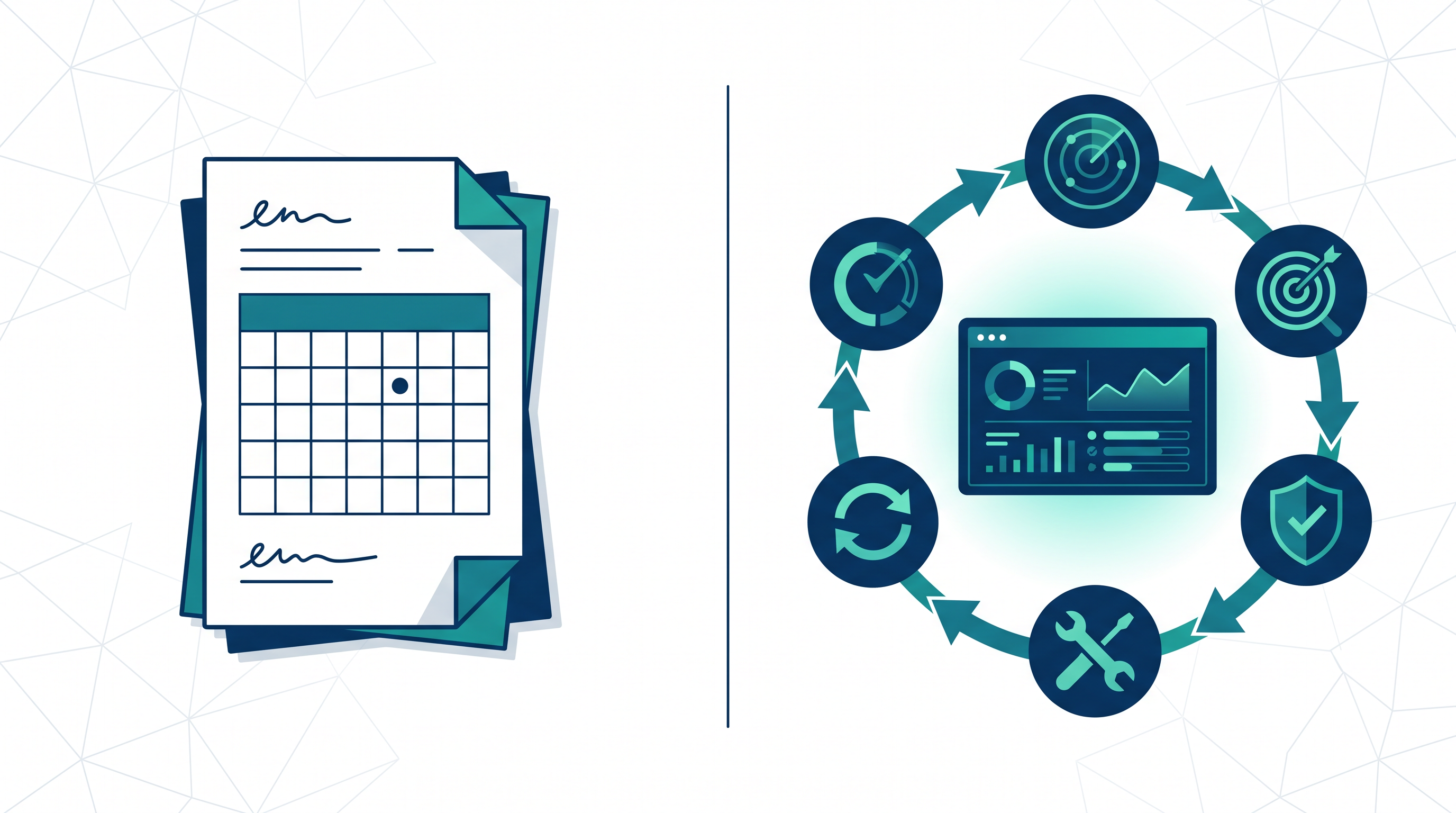
Most PTaaS offerings combine automation with human expertise. Automated agents handle discovery and repeatable testing at scale, while analysts validate and prioritize findings. The balance between the two varies by provider and by plan, which is a point worth checking before you buy. Privaxi's PTaaS is powered by CYRIK AI Recon and follows a five-step loop: discover, test, validate, remediate and retest.
What Is Traditional Penetration Testing?
Traditional penetration testing is a time-boxed engagement led by human testers. A scope is agreed, testers spend a fixed number of days attacking the in-scope systems, and you receive a detailed report at the end, usually with an executive summary, technical findings and remediation advice. A retest may be included or sold separately.
Its strength is depth. Skilled testers can chain subtle weaknesses, exploit business-logic flaws and explore the application the way a motivated attacker would. We explain the full process in our guide to penetration testing services.
PTaaS vs Traditional Penetration Testing: Side-by-Side
Advantages of Penetration Testing as a Service
Coverage stays current
A traditional test captures one moment. PTaaS repeats testing so that new hosts, open ports and exposed services are found shortly after they appear rather than months later. Privaxi's approach re-tests when new hosts or services show up, which closes the window between annual tests.
Faster remediation cycles
When findings arrive in a portal as they are confirmed, engineers can fix them in the normal sprint cycle instead of receiving a 90-page report weeks after testing ended. Built-in retesting then confirms the fix without a new statement of work.
Predictable cost
Subscription pricing makes budgeting simpler. Published Privaxi plans, for example, start at $499 per month for 1 to 10 IPs and scale by the number of internet-facing endpoints. See how much penetration testing costs for what drives pricing across both models.
Useful for compliance and questionnaires
Regular reports mapped to controls make it easier to answer customer questionnaires and support audits. Privaxi maps results to frameworks including PCI DSS Requirement 11.4, SOC 2 CC7.1, ISO 27001 Annex A 8.8 and HIPAA. Whether any single report satisfies a specific requirement should always be confirmed against the standard and with your assessor.
Limits of PTaaS
- Depth depends on the plan. Automated, recurring testing is excellent at finding exposed services, misconfigurations and known exploitable weaknesses. Complex business-logic flaws, such as abusing a checkout or approval workflow, still need skilled manual testing.
- Scope is often external first. Many PTaaS plans focus on internet-facing assets. Internal networks and application-level testing may need a separate engagement.
- Human validation varies. Ask which findings are reviewed by an analyst and on which tier. Privaxi's higher tiers add analyst review and proof of exploitation on confirmed issues.
- Subscription is not a substitute for scope discipline. You still need to define which assets are covered, as we explain in our guide to penetration testing scope.
Advantages of Traditional Penetration Testing
- Depth on complex systems. Multi-step attack chains, role abuse and business-logic testing are where experienced testers add the most value.
- Clear audit milestone. A dated, signed report from an independent tester is the evidence many auditors and customers expect.
- Tailored scope. You can focus the entire engagement on one new application, one release or one compliance boundary.
- Detailed narrative. A good report explains the attack path in language developers and executives can act on.
When to Choose PTaaS
- Your external attack surface changes often because of cloud deployments, new domains or acquisitions.
- You need evidence of regular testing for customers, insurers or frameworks that expect more than an annual snapshot.
- You want predictable spend and a single place to track findings and retests.
- Your team is small and cannot manage multiple scoping and procurement cycles each year.
When to Choose Traditional Penetration Testing
- You are launching or substantially changing a customer-facing application.
- An auditor or contract requires a named, signed report on a specific date.
- You need deep testing of business logic, authentication and authorization.
- You have a complex internal environment that needs hands-on assessment.
Why Most Mature Programs Use Both
The strongest security programs treat the two models as complementary. Continuous or monthly external testing keeps the perimeter honest between engagements, and an annual deep-dive test covers applications and internal networks. The findings from each feed the other: recurring tests surface new exposures to include in the next scope, and manual tests reveal weaknesses that automated checks can be tuned to monitor.
This also lines up with how modern frameworks think about assurance. We discuss the shift in why continuous compliance beats annual audits, and the same logic applies to testing.
How Privaxi's Penetration Testing as a Service Works
To make the comparison concrete, here is how Privaxi delivers its penetration testing as a service program, powered by CYRIK AI Recon:
- Discover. The platform maps your internet-facing hosts, ports and services so that testing starts from what is actually exposed, not from an outdated asset list.
- Test. Autonomous agents simulate attacker behavior against discovered assets and look for exploitable weaknesses.
- Validate. Findings are checked to filter out false positives. Analyst review and proof of exploitation are added on higher tiers.
- Remediate. You receive severity-ranked findings with remediation guidance in a portal.
- Retest. Once you fix an issue, testing runs again to verify the fix.
Pricing is published on a per-IP basis, which makes it easy to compare against a project quote:
Larger environments are quoted individually. Compare these figures with a traditional quote only after confirming that both cover the same assets and the same depth; our guide to how penetration testing cost is calculated explains why equal-scope comparison matters.
PTaaS and Compliance: Which Controls Does It Support?
Subscription testing is often bought for compliance reasons, so it helps to see which controls the output is mapped to. Privaxi maps PTaaS results to the following, and each mapping should still be validated with your assessor:
For frameworks that expect testing at set intervals, the continuous model generates more frequent evidence. For frameworks that expect a specific named test, such as PCI DSS segmentation testing, a traditional engagement may still be needed alongside it.
Red Flags When Evaluating PTaaS Vendors
- Vague claims about "AI" with no detail on what the automation actually does and where humans step in.
- No retesting or retesting that is billed as an extra.
- Reports you cannot share. If you cannot hand a summary to a customer or auditor, the value drops sharply.
- Unclear endpoint definitions. If you cannot tell what counts toward your plan, the invoice will surprise you.
- No rules of engagement. Production testing without written authorization and safe-testing limits is a risk.
A Practical Hybrid Testing Roadmap
If you are unsure how to combine the two models, this sequence works for many growing companies:
- Start with a baseline. Run an external assessment, or the free single-domain test, to see what your perimeter looks like today.
- Fix the quick wins. Close exposed services, patch known vulnerabilities and remove forgotten assets.
- Turn on recurring external testing. Choose a plan that covers your public IPs and set alerts for new findings.
- Schedule an annual deep-dive test. Focus it on your main application, APIs and any compliance boundary.
- Retest after every major change. Use the platform for infrastructure changes and the manual team for application changes.
- Report on trends. Track findings opened, closed and time to remediate to show progress to leadership and customers.
How to Choose a PTaaS Provider
- Ask what is automated and what is human. Request specifics on which findings are validated by an analyst.
- Check scope coverage. Confirm whether web applications, APIs and cloud assets are included, or only IP-level testing.
- Look at retesting. It should be included and easy to trigger.
- Review the reporting. Reports should map to the frameworks you care about and be shareable with customers.
- Confirm pricing mechanics. Understand what counts as an endpoint, what happens when you exceed the tier and whether extra scans cost more.
- Evaluate the provider's credibility. Our checklist for choosing a penetration testing company applies to PTaaS vendors too.
If you want to see the model in practice, you can start with a free external assessment of one domain through Privaxi's AI penetration testing program and compare the output with a traditional report.
Frequently Asked Questions About PTaaS vs Traditional Penetration Testing
What is PTaaS?
PTaaS, or penetration testing as a service, is a subscription model in which penetration testing is delivered continuously or on a recurring schedule through a platform that provides live findings, remediation guidance and retesting.
Is PTaaS better than traditional penetration testing?
Neither is better in every case. PTaaS is better for keeping up with a changing external attack surface and for regular evidence of testing. Traditional testing is better for deep, manual assessment of applications and for dated audit milestones. Many organizations use both.
Can PTaaS replace an annual penetration test?
It can replace part of the program for external infrastructure, but it does not always replace a scoped annual test of applications and internal systems. Check what your auditor, customers and chosen framework require.
How much does PTaaS cost compared with a traditional pen test?
PTaaS is usually a recurring monthly or annual fee based on the number of assets, while traditional testing is a fixed project fee based on scope and effort. Over a year, PTaaS spreads cost and includes retesting, while a traditional test concentrates it in one engagement.
Does PTaaS meet compliance requirements like PCI DSS or SOC 2?
PTaaS reports can support PCI DSS, SOC 2, ISO 27001, HIPAA and similar programs, especially when results are mapped to controls. Whether a given report satisfies a requirement depends on the standard and your assessor, so confirm scope and tester qualifications before relying on it.
Is continuous penetration testing safe for production systems?
Reputable providers agree on rules of engagement, test windows and safe testing techniques before starting, and use non-destructive methods on production assets. Confirm these details in writing.
Final Thoughts
The real question behind PTaaS vs traditional penetration testing is not which model wins but which risks each one covers. PTaaS keeps pace with change and gives you continuous evidence. Traditional testing goes deeper on the systems that matter most and gives you a defensible milestone.
If you want to see how the subscription model fits your environment, explore Privaxi's penetration testing as a service and book a call to scope the right mix.
Related Articles



Secure Your Business's Future
Contact us today for a personalized consultation and see how we can tailor a security solution that fits your business needs perfectly.
